
Simplifying learning through practical guides, educational resources, and easy-to-understand explanations.

What colors can be mixed to make red?

0
1.2K

Join this conversation

Sort By
Replying to the question above
Updated on07/24/26

Can you mix colors to make red? The answer depends on your medium. In traditional painting (the RYB color model), red is a primary color, meaning you technically cannot mix other primary colors to create a true, pure red. However, in the modern subtractive color model used in printing (CMYK), the answer to exactly what colors make red is a balanced mixture of Magenta and Yellow.

If you already have a basic red paint and simply want to know how to alter it, you can mix it with yellow to create warm reds (like scarlet), blue to create cool reds (like crimson), or a touch of green/black to create deep, moody reds (like burgundy).

In this guide you will learn:

  • The difference between traditional and modern color theory.

  • Exactly what color to make red using the CMYK printing method.

  • Expert tips for mixing different shades and tints of red.

  • Answers to common FAQs about primary and secondary color combinations.

The Great Debate: Is Red Really a Primary Color?

If you ever took a basic art class, you were likely taught the RYB (Red, Yellow, Blue) color model. In this traditional system, red is considered a fundamental primary color. According to this rule, primary colors cannot be created by mixing other colors together; instead, they are the building blocks used to create every other color on the wheel. So, if you run out of pure red acrylic paint, traditional theory says you are out of luck.

However, modern science and digital printing have given us a different answer to what make red.

The CMYK Method: Magenta + Yellow = Red

Printers use the CMYK (Cyan, Magenta, Yellow, and Key/Black) color model. This is a subtractive color model. In this scientifically accurate system, the true primary colors of pigment are actually cyan, magenta, and yellow.

If you are wondering exactly what color to make red using this modern scientific model, you simply mix pure Magenta and pure Yellow.

  • Magenta absorbs green light and reflects red and blue.

  • Yellow absorbs blue light and reflects red and green.

  • When mixed, the blue and green light are both absorbed, leaving only Red to reflect back to your eyes.

Therefore, if you have a tube of primary magenta paint and a tube of primary yellow paint, you can mix them together to create a vibrant, brilliant red!

How to Mix Different Shades of Red

While creating a pure primary red from scratch requires magenta, you will often find yourself needing to modify an existing red paint to fit your specific artistic needs. By adding trace amounts of other colors, you can shift the temperature and depth of your red.

Here is a quick reference guide on how to modify a basic red base:

Target Shade

Base Color

Colors to Add

Resulting Vibe

Crimson

Pure Red

Tiny drop of Blue

Cool, deep, and dramatic

Scarlet / Tomato

Pure Red

Small amount of Yellow

Warm, fiery, and energetic

Maroon / Burgundy

Pure Red

Touch of Brown, Black, or Green

Rich, dark, and sophisticated

Pink / Rose

Pure Red

White

Soft, delicate, and pastel

Coral

Pure Red

White + tiny drop of Yellow

Tropical and vibrant

Expert Tips for Mixing Red Paint

If you are standing at your canvas wondering what color make red darker, lighter, or more muted, follow these expert color-mixing rules to avoid creating a muddy mess:

  • To darken red, use its complementary color: While your first instinct might be to add black to make a dark red, black can quickly make red look dull or "dirty." Instead, add a microscopic touch of green (red's complementary color on the color wheel). This darkens the red while keeping it rich and vibrant.

  • Always add dark to light: When mixing your own red using magenta and yellow, start with a large pool of yellow (the lighter color) and slowly mix in the magenta. It is much easier to darken a light color than to lighten a dark one.

  • Watch your color temperatures: Remember that not all reds are created equal. If you are painting a vibrant sunset, lean towards mixing your red with yellow for a warm scarlet. If you are painting a dark rose, mix your red with a touch of blue for a cooler crimson.

  • Use Titanium White carefully: When trying to lighten red, adding white will immediately turn it pink. If you want a lighter red without losing its fiery identity, try adding a bright, opaque yellow instead.

Frequently Asked Questions (FAQ)

Can I make red if I only have primary colors? If you are using traditional RYB primary colors (Red, Yellow, Blue), you cannot mix yellow and blue to create red. Red is already a primary color in this system. However, if your "primary" colors are CMYK (Cyan, Magenta, Yellow), you can mix magenta and yellow to create red.

What colors make red darker without using black? To darken red without making it look muddy or gray, add a very small amount of its complementary color: green. Alternatively, a tiny drop of dark blue (like Ultramarine) will create a deep, beautiful burgundy.

If I mix pink and orange, will it make red? Mixing a highly saturated, dark pink (which contains magenta) with a vibrant orange (which contains yellow and red) can yield a warm, peachy-red color, though it will likely lack the brilliant punch of a pure primary red.

What make red look warmer? To make a red appear warmer, mix in a small amount of yellow or bright orange. This pushes the hue toward a fiery scarlet or vermilion.

Conclusion

Understanding what colors make red is a fantastic gateway into the broader world of color theory. While traditional art rules dictate that red is an unmixable primary color, modern CMYK science proves that a perfect blend of magenta and yellow will give you a brilliant, true red. Whether you are adjusting digital graphics or mixing acrylic paints on a palette, knowing how to manipulate red with yellows, blues, and complementary greens will elevate your creative projects to the next level.

Also Read: What color does mixing green and blue make?
Sources & References

M
Researching color theory, pigment mixing & creative design principles.
View Profile

Madan Singh is an education consultant and content writer with 8+ years of experience advising students, parents, and educational institutions on academic pathways, career planning, and learning strategies. He holds a Master's degree in Education Management from Delhi University, a background that grounds his writing in structured pedagogical thinking rather than generic career advice. His work spans college admissions guidance, career counselling, study abroad pathways, and competitive exam preparation, with a focus on both Indian and international education systems. He writes for CollegeDekho, Shiksha.com, and Collegedunia, where his articles are aimed at students and families making academic decisions. Over the course of his consulting practice, Madan has advised 150+ students on admissions, scholarship applications, and career planning. He has published 80+ articles across education platforms during this time, covering topics from exam strategy to international study options. Madan's approach is practice-first: his writing reflects the questions he actually gets from students and parents, not templated advice. He does not claim to cover every education topic — his focus stays on admissions, career planning, and study-abroad guidance, where his consulting experience directly applies.

0
Replying to the question above
Updated on07/23/26

To make red paint or ink, you must mix magenta and yellow. While you may have been taught that red is a primary color that cannot be created by mixing other colors, this depends entirely on which color system you are actively using.

Article image

The widespread confusion stems from the historical difference between traditional art education and modern color science.

The Modern Science: Magenta + Yellow

In the modern subtractive color model—which is how printers, inks, and modern synthetic paints work—the true primary colors are cyan, magenta, and yellow (CMYK). In this scientifically accurate system, red is actually a secondary color.

When you mix equal parts of pure magenta and bright yellow pigment, you create a vibrant, true red. This works because pigments absorb (subtract) light. Magenta absorbs green light, and yellow absorbs blue light. When combined, the only wavelengths left to reflect back into your eye are red.

By adjusting the ratio, you can control the exact shade of the output:

  • More Magenta: Adding a higher ratio of magenta creates a deeper, cooler red, similar to crimson or burgundy.

  • More Yellow: Adding extra yellow results in a warmer, fiery red-orange or a classic tomato red.

The Traditional Art Model

In elementary school art classes, we are widely taught the traditional Red-Yellow-Blue (RYB) color model. In this older system, red is considered a fundamental primary color that cannot be mixed from scratch. If you are using a standard beginner's paint set that only includes a basic red, yellow, and blue, you will simply not be able to mix a true red. You can only modify the red you already have by adding tiny amounts of other colors to shift its temperature or darkness.

Mixing Light (Digital Design)

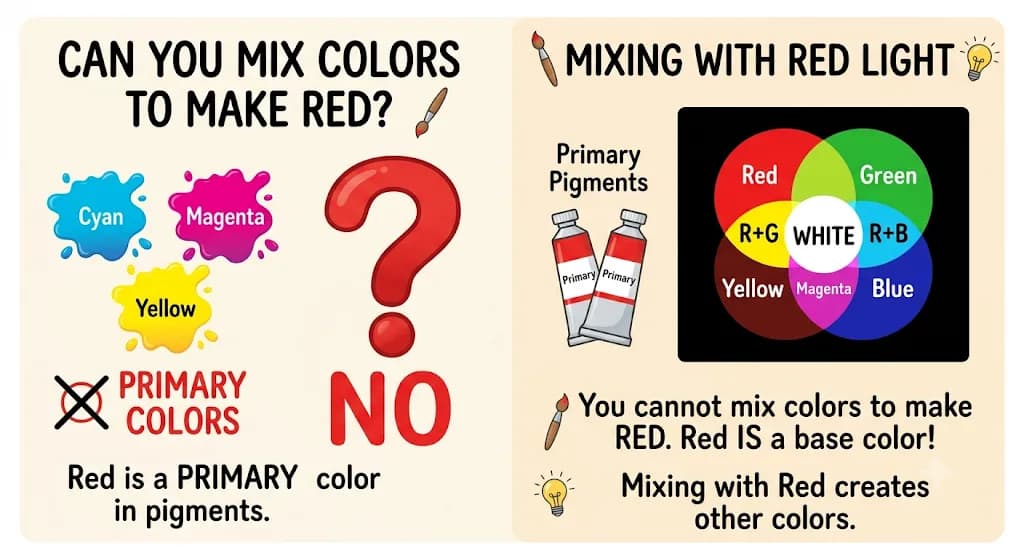
It is important to note that if you are mixing colored light—such as working in digital graphic design, theater lighting, or photography—you are using the additive color model (RGB). In light, Red, Green, and Blue are the absolute primary colors. You cannot mix other colored lights to create red; it is the foundational starting point.

Ultimately, if you are staring at a blank physical palette and need to create a bright red from scratch, grab your magenta and yellow tubes and start mixing.


Also Read: What color does mixing green and blue make?

O
Generate an image for 'What colors can be mixed to make red?'
View Profile
0
Replying to the question above
Answered on06/16/26

No, you cannot create pure red by mixing other colors in the traditional paint color model. The thing is, red is a primary color, which means it is one of the basic colors that cannot be produced by mixing other paint colors together.

If you need true red, you'll have to start with red paint or pigment.

I think this is where many people get confused because there are different color models.

In the traditional RYB (Red, Yellow, Blue) color model used in painting, red is a primary color. Since primary colors are the foundation of all other colors, they cannot be created by mixing other colors.

Instead, red is used to create many secondary and tertiary colors, such as:

  • Red + Yellow = Orange

  • Red + Blue = Purple (Violet)

  • Red + White = Pink

  • Red + Black = Maroon or Dark Red

So, while you can create many shades from red, you cannot create pure red without already having red.

Exceptions 

To be honest, the answer changes slightly depending on the color system you're using.

  • Paints (RYB or CMYK): Pure red cannot be made by mixing other colors.

  • Light (RGB): Red is one of the three primary colors of light, along with green and blue, so it also cannot be created by mixing other light colors.

  • Printing (CMYK): Red is produced by combining magenta and yellow inks. However, this creates printed red rather than a pure primary paint pigment.

That is why you may come across different answers depending on whether people are talking about paints, printing, or digital screens.

How to Create Similar Shades

Although you cannot make pure red, you can create colors that look similar by adjusting red with other colors:

  • Red + White = Pink

  • Red + Black = Maroon

  • Red + Brown = Brick Red

  • Red + Orange = Vermilion-like shades

  • Red + Purple = Crimson or Burgundy tones

I remember trying to mix paints as a child, hoping I could create red from other colors. The thing is, no matter what combination I tried, I could only make shades that looked close to red, not true red itself. That's when I learned that red is a primary color and has to be used as the starting point.

Must Read: Which two colors are mixed together to form a green color?

Tara Verma
Exploring the science behind colors and creativity
View Profile

Tara Verma is a practising teacher and education content writer with over 10 years of classroom experience across primary and secondary levels. She holds a Master's degree in Education (M.Ed.) from Delhi University and a Bachelor of Education (B.Ed.) from Jamia Millia Islamia — qualifications that ground her writing in both pedagogical theory and the day-to-day realities of teaching in India. Her content covers exam preparation strategies, learning methodologies, curriculum guidance, student mental health, career counselling for students, and the evolving state of school and higher education in India. Her work has appeared on platforms including TeacherVision India, Jagran Josh, and Careers360, where she writes for students, parents, and fellow educators who need content built on actual teaching experience — not theory alone. Over a decade of working directly with students across age groups and learning levels has given Tara a practical understanding of how education content should be written — clearly, accessibly, and with genuine awareness of the challenges students and teachers face on the ground. She has taught 1,000+ students, contributed to school curriculum development initiatives, and published 250+ articles on education across digital platforms. She is an active member of the National Council of Teachers of English (NCTE) India. Across all her writing, every recommendation is classroom-tested, every insight comes from direct teaching experience, and every article is held to the same standard she applies in her own classroom — accuracy, clarity, and genuine usefulness for the reader.

0
Replying to the question above
Updated on12/23/25

First method : Understanding Color Theory

1 . Know that you cannot make red. Red is a number one colour, so that you cannot create it by means of mixing every other colorings.
Primary shades are colors that exist on their very own and do now not contain traces of another color. Aside from pink, the opposite primary colorations are blue and yellow.
 
Even even though you can't make pure crimson, you could still make other colorations of pink by using mixing natural red with different colours. You can exchange the cost of any purple hue in a comparable manner.
 
2 . Change the hue by including other colorations. Mixing natural purple with different colors will trade the hue. You can integrate it with most number one and secondary colours, and each combination can have special consequences.
 
When combining crimson with the alternative number one colours, you ought to best upload a small quantity of the alternative shade to prevent the crimson from changing shade absolutely. A little yellow can create an orange-pink hue, however an excessive amount of will create orange. Small quantities of blue can create a violet-crimson hue, however too much makes violet.
 
Mixing crimson with the secondary color orange will make orange-red, but you need to restrict the amount of orange to an same part or much less to save you the hue from becoming greater orange than purple. Similarly, blending red with the secondary colour violet will make violet-crimson, however you ought to restriction the violet to an equal component or much less.
 
You also can blend purple with small quantities of the very last secondary coloration, inexperienced. Since the 2 are enhances (two colorings lying on opposite facets of the shade wheel), adding inexperienced to crimson will provide the crimson a hint of brown. Adding an excessive amount of will trade the pink to brown or muddy gray, though.
 
 
3 . Alter the cost via adding black or white. If you need to change the fee of pink without changing the hue, you'll want to combine pure pink with white or black.
 
Adding white will lighten the tint. Too a whole lot white creates crimson, though.
 
Adding black will darken the color. Too tons black can make it difficult to differentiate the original pink hue, however.
 
Second method : Mixing Red Paint 
 
1 . Prepare numerous paints. When portray, you'll probably want numerous hues of purple. You can create maximum hues by combining pure crimson with different hues.
 
At minimum, you ought to have red, yellow, blue, orange, violet, inexperienced, black, and white paints. Try to select paints that are as close to the pure hue as viable for every colour.
 
2. Examine the natural purple. Squeeze a small dot of red paint onto your painting palette. Use a paintbrush to transfer a stroke of this paint onto the center of some scrap paper.
 
Take a good look at the pink streak. This may be your authentic sample, and you must evaluate it to the other reds you mix in the course of the relaxation of the manner.
 
3 . Practice blending crimson with other number one colours. Add a small amount of yellow to 1 spot and a small amount of blue to the other.
For both addition, paintings in vary small amounts and blend them in till no streaks continue to be. Adding an excessive amount of of both colour can modify the pink too significantly and exchange it into any other hue.
 
Paint a line of orange-purple (made with the yellow) to 1 side of your unique red streak. Paint a line of violet-red (made with blue) to the alternative facet of the authentic red streak. Compare the different colours.
 
Mix purple with orange and violet. Start with two fresh spots of pink paint. Add orange paint to 1 and violet paint to the opposite.
 
4. You have to be capable of blend the 2 colours in same elements and still make a purple hue, however the red element could be more potent if you use a little less of the secondary shade (orange or violet).
 
Paint a line of your new orange-crimson next to the previous orange-crimson. Paint a line of your new violet-red next to the previous violet-pink. Compare those new colorings to their counterparts and to the unique red pattern.
 
5 . Combine the purple with green. Squeeze sparkling pink onto the palette and blend in a completely small quantity of green. The red should trade right into a reddish-brown.
 
It's quality initially small dots of inexperienced. If favored, you may gradually add extra inexperienced in small increments to in addition regulate the hue. Adding too much will create brown or gray-brown paint, however.
 
Paint a streak of your new colour onto the paper, somewhere near the unique crimson pattern. Compare the colours.
 
6 . Change the tint. Add a bit white to fresh purple paint and a bit black to some other dab of clean purple. Mix thoroughly.
 
Paint a streak of the darkened red near the red-brown sample and examine them; each shades need to be dark, however the pink-brown pattern ought to have a awesome brown detail, even as the darkened red must no longer.
 
Paint a streak of the lightened purple onto the paper, too. Compare the tint with the other samples.
C
View Profile

Hi , I am Chhavi Tyagi. Basically i have done B.tech from computer science . I am a Digital Marketer as a profession

0