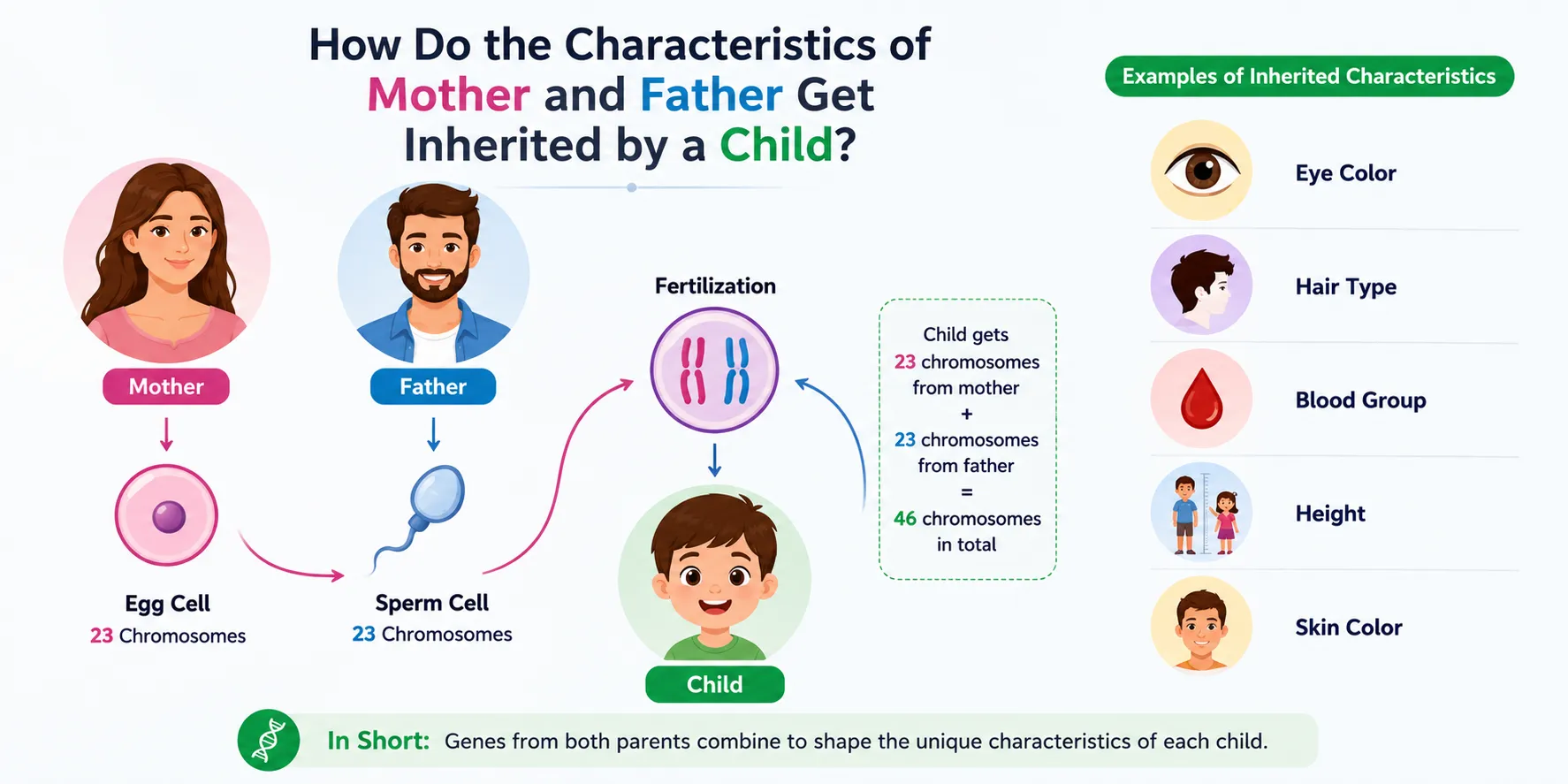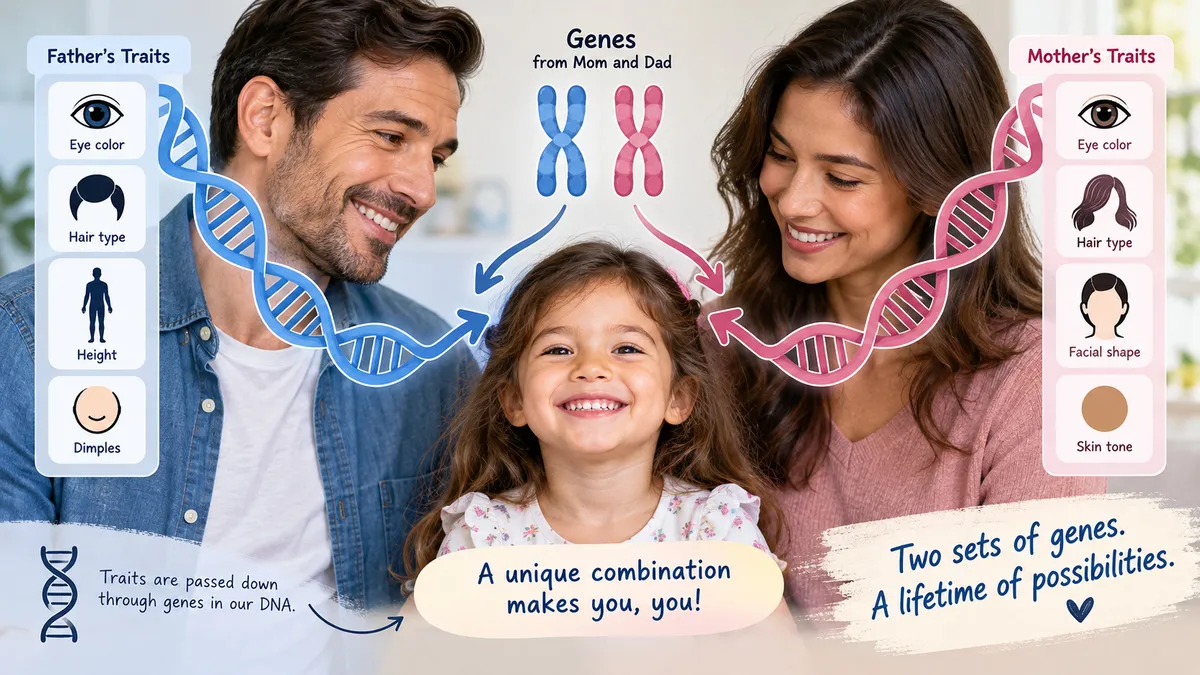
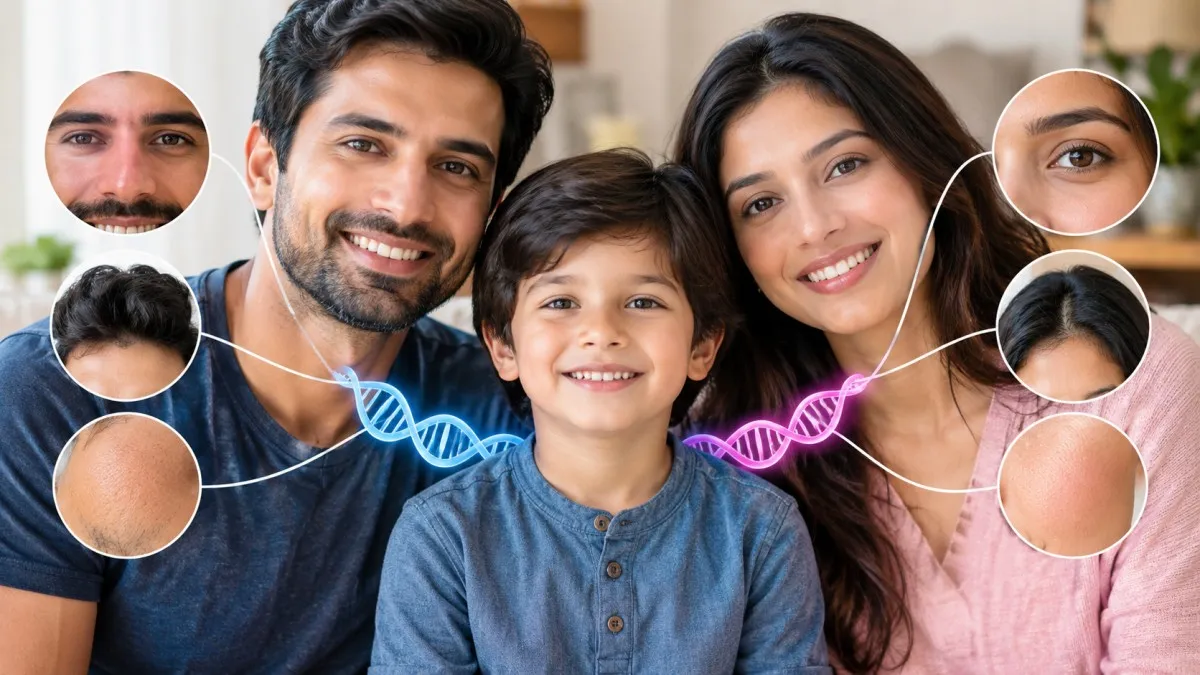
A child inherits traits through DNA passed down through chromosomes – 23 from the mother’s egg and 23 from the father’s sperm, totaling 46 chromosomes. Each parent gives one copy of every gene, and the version that appears in the child depends on whether that gene is dominant, recessive, or part of a more complex inheritance pattern involving multiple genes.
Where Inheritance Really Begins
Genes are parts of DNA that are found on chromosomes. All cells in the human body have genes. Sperm and egg cells are different from other cells of the body in that they contain only half the normal number of chromosomes – 23 instead of 46.
When sperm and egg meet, the two sets come together. The new cell, and every cell it will give rise to, has one complete set of 23 pairs of chromosomes: one from mom, one from dad, for each pair.
Genes come in pairs and pairs don’t always agree
For most traits, a child inherits two versions of a gene — one from each parent. These versions are called alleles and are not always the same.
Consider eye color as a simple example. When one parent gives a child a brown-eye allele and the other a blue-eye allele, brown tends to win out because that allele is dominant. The blue allele doesn’t disappear, it’s just tucked away until the child passes it on to their own children, who may combine it with another blue allele.
Geneticists categorize this behavior into a few patterns:
Pattern | How it works | Example trait |
|---|---|---|
Dominant | One copy is enough to show the trait | Dimples, dark hair (generally) |
Recessive | Both copies must match for the trait to show | Red hair, blue eyes (in many cases) |
Codominant | Both versions show up together, fully | AB blood type |
Polygenic | Many genes combine to produce the trait | Height, skin tone, eye color (more accurately) |
Eye color, by the way, isn't really a single dominant-recessive story. Research suggests there are at least 8 to 16 genes involved, which explains why two brown-eyed parents can sometimes have a child with hazel or green eyes.
Why Siblings from the Same Parents Look Different
Full siblings have the same two parents but they are not usually identical. That's because of a process called genetic recombination. It mixes up the combinations of genes when each egg and sperm cell is made.
Every child ends up with a different combination of the parents’ genes. This is why one sibling might inherit mom’s curly hair and dad’s height, and another might inherit the opposite combination.
Beyond Looks: What Else is Inherited
The most obvious inheritance is physical appearance, but not the only one. Children can inherit too:
Blood type based on A, B, and O allele combinations
Risk for certain health conditions, such as some cancers or some heart conditions, where a gene variant runs in the family
Population variation in metabolic traits, e.g. lactose tolerance
Behavioral propensities, which are a mix of genes and environment, not a single gene
How Things Are Not Inherited the Same Way
Not everything that happens to a parent is passed on genetically. A father who has spent years in the gym building up his muscles does not pass on “built muscles” to his child — the child receives the inherited potential for building muscle, not the acquired result.
That distinction is important in a field called epigenetics, a newer area of research into how environment and lifestyle can turn some genes on or off without changing the DNA sequence itself. Some epigenetic changes appear to be passed down to one or two generations. As of 2026, this research is still developing and scientists are still working out how significant the effect is in humans.
References
MedlinePlus Genetics — What is a gene?
https://medlineplus.gov/genetics/understanding/basics/gene/MedlinePlus Genetics — What are the different ways a genetic condition can be inherited?
https://medlineplus.gov/genetics/understanding/inheritance/inheritancepatterns/MedlinePlus Genetics — Is eye color determined by genetics?
https://medlineplus.gov/genetics/understanding/traits/eyecolor/National Human Genome Research Institute (NHGRI) — Talking Glossary of Genomic and Genetic Terms.
https://www.genome.gov/genetics-glossaryCenters for Disease Control and Prevention (CDC) — Genomics and Health.
https://www.cdc.gov/genomics-and-health/National Human Genome Research Institute (NHGRI) — Epigenomics.
https://www.genome.gov/about-genomics/fact-sheets/Epigenomics-Fact-Sheet