The answer depends on what period is being referring to.
- If we're talking about British political rule over India, the British ruled for about 190 years, from the Battle of Plassey in 1757 until India gained independence on 15 August 1947.
- If we're including the arrival of the British East India Company as a trading company, the British presence in India began in 1600, making it about 347 years from the Company's founding until independence in 1947. However, they did not rule India politically during all of those years.
This is where many people get confused. You'll often hear 190 years, 200 years, or even 350 years, and each number refers to a different stage of British involvement in India.
Beginning of British Rule
The British first came to India for trade, not to govern.
In 1600, Queen Elizabeth I granted a royal charter to the British East India Company, allowing it to trade in Asia. Initially, the Company established trading factories in places like Surat, focusing on spices, textiles, silk, and other valuable goods.
Everything changed after the Battle of Plassey (1757).
The East India Company defeated Siraj-ud-Daulah, the Nawab of Bengal, with the support of Mir Jafar. Historians widely consider this battle the beginning of British political dominance in India because it gave the Company enormous influence over Bengal and eventually much of the Indian subcontinent.
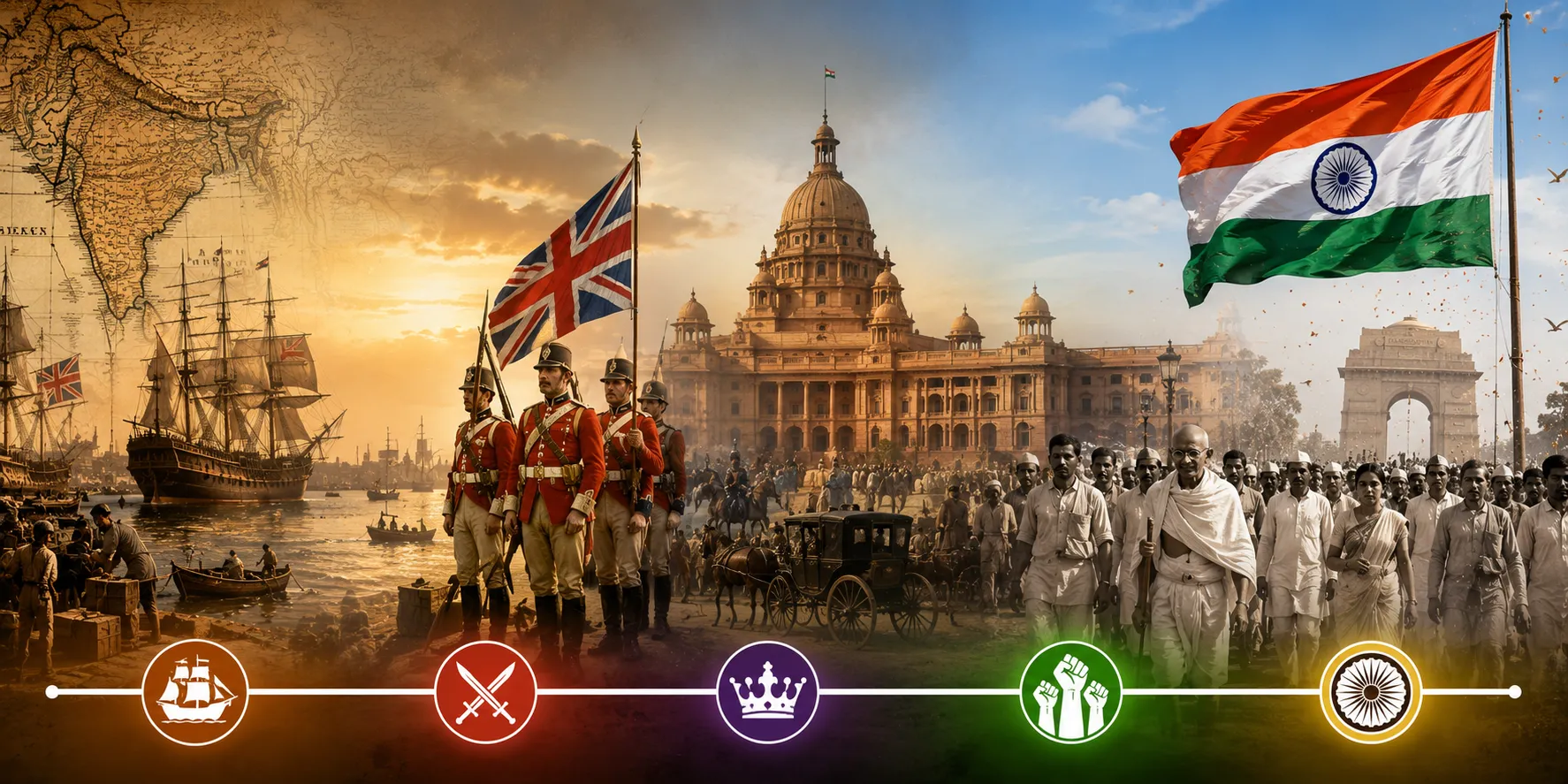
Timeline of British Rule
British rule in India can be divided into two major phases.
| Period | Years | What Happened |
|---|---|---|
| East India Company Rule | 1757–1858 | A private trading company gradually expanded its political and military control over large parts of India. |
| British Crown Rule (British Raj) | 1858–1947 | After the Revolt of 1857, the British government took direct control from the East India Company. |
Phase 1: East India Company Rule (1757–1858)
Although it started as a business, the East India Company eventually became one of the most powerful governing bodies in history.
During this period, the Company:
- Collected taxes.
- Maintained its own army.
- Controlled large territories.
- Fought numerous wars against Indian kingdoms.
This wasn't a government in the traditional sense. It was a private company exercising political power on an extraordinary scale.
Phase 2: British Raj (1858–1947)
The Revolt of 1857 changed everything.
After suppressing the uprising, the British Parliament passed the Government of India Act 1858, ending East India Company rule and transferring authority directly to the British Crown. This period became known as the British Raj.
Major Events During British Rule
British rule shaped India's political, economic, and social landscape in many ways.
Some of the most significant events include:
- 1600 – East India Company established.
- 1608 – First English trading factory established at Surat.
- 1757 – Battle of Plassey.
- 1764 – Battle of Buxar strengthened Company control.
- 1857 – Revolt of 1857 (First War of Independence).
- 1858 – Beginning of the British Raj.
- 1885 – Formation of the Indian National Congress.
- 1919 – Jallianwala Bagh massacre.
- 1930 – Dandi Salt March led by Mahatma Gandhi.
- 1942 – Quit India Movement.
- 15 August 1947 – India became independent.
One detail that often gets overlooked is that British rule didn't remain the same throughout its history. The India governed by the East India Company was very different from the India governed directly by the British Crown after 1858.
Impact of British Rule
British rule left behind a complex legacy that historians continue to debate.
Some long-lasting developments included:
Infrastructure
- Expansion of railways.
- Telegraph network.
- Postal system.
- Modern administrative institutions.
Education
- Introduction of English-language education.
- Establishment of universities.
- Development of a modern civil service.
Economic Consequences
- Heavy taxation.
- Deindustrialization of several traditional industries.
- Famines during colonial rule.
- Large-scale extraction of resources for the British Empire.
Because of this mixed legacy, discussions about British rule often include both institutional developments and the enormous human and economic costs of colonialism.
End of the Period
British rule officially ended on:
15 August 1947
India gained independence after decades of political movements, civil disobedience campaigns, negotiations, and growing demands for self-rule.
Independence also led to the Partition of British India, creating the two independent dominions of India and Pakistan, accompanied by one of the largest and most tragic migrations in modern history.
Common Misconceptions
"The British ruled India for exactly 200 years."
Not exactly.
If you're referring to political rule, the commonly accepted duration is about 190 years (1757–1947).
"The British started ruling India in 1600."
No.
They arrived as traders in 1600. Political control began much later, after the Battle of Plassey in 1757.
"The East India Company and the British Raj were the same."
They weren't.
The East India Company was a private commercial company.
The British Raj was direct rule by the British government after 1858.
British Rule in India at a Glance
| Feature | Details |
|---|---|
| British Arrival | 1600 (East India Company) |
| Political Rule Began | 1757 (Battle of Plassey) |
| British Raj Began | 1858 |
| Independence | 15 August 1947 |
| Length of Political Rule | About 190 years |
British involvement in India lasted for centuries, but it's important to distinguish between trade and political rule. The British first arrived as merchants through the East India Company in 1600, yet their political dominance is generally traced to the Battle of Plassey in 1757. After the Revolt of 1857, direct control shifted from the Company to the British Crown, marking the beginning of the British Raj, which continued until India achieved independence on 15 August 1947. Understanding these different phases helps explain why historians cite different durations for British rule while referring to the same period of history.
Frequently Asked Questions (FAQs)
1. How many years did the British rule India?
British political rule lasted for about 190 years, from 1757 to 1947.
2. When did British rule in India begin?
Most historians consider 1757, after the Battle of Plassey, as the beginning of British political rule.
3. What was the difference between the East India Company and the British Raj?
The East India Company was a private trading company that governed parts of India until 1858, after which the British Crown took direct control under the British Raj.
4. Why did British rule end in India?
British rule ended due to decades of India's freedom movement, political negotiations, growing public resistance, and changing global circumstances after World War II.
5. Did the British come to India to rule?
No. They initially came for trade through the East India Company. Political control developed gradually over time through military victories and administrative expansion.
Must Read: When did the English East India Company arrive in India?