Answered on09/12/26
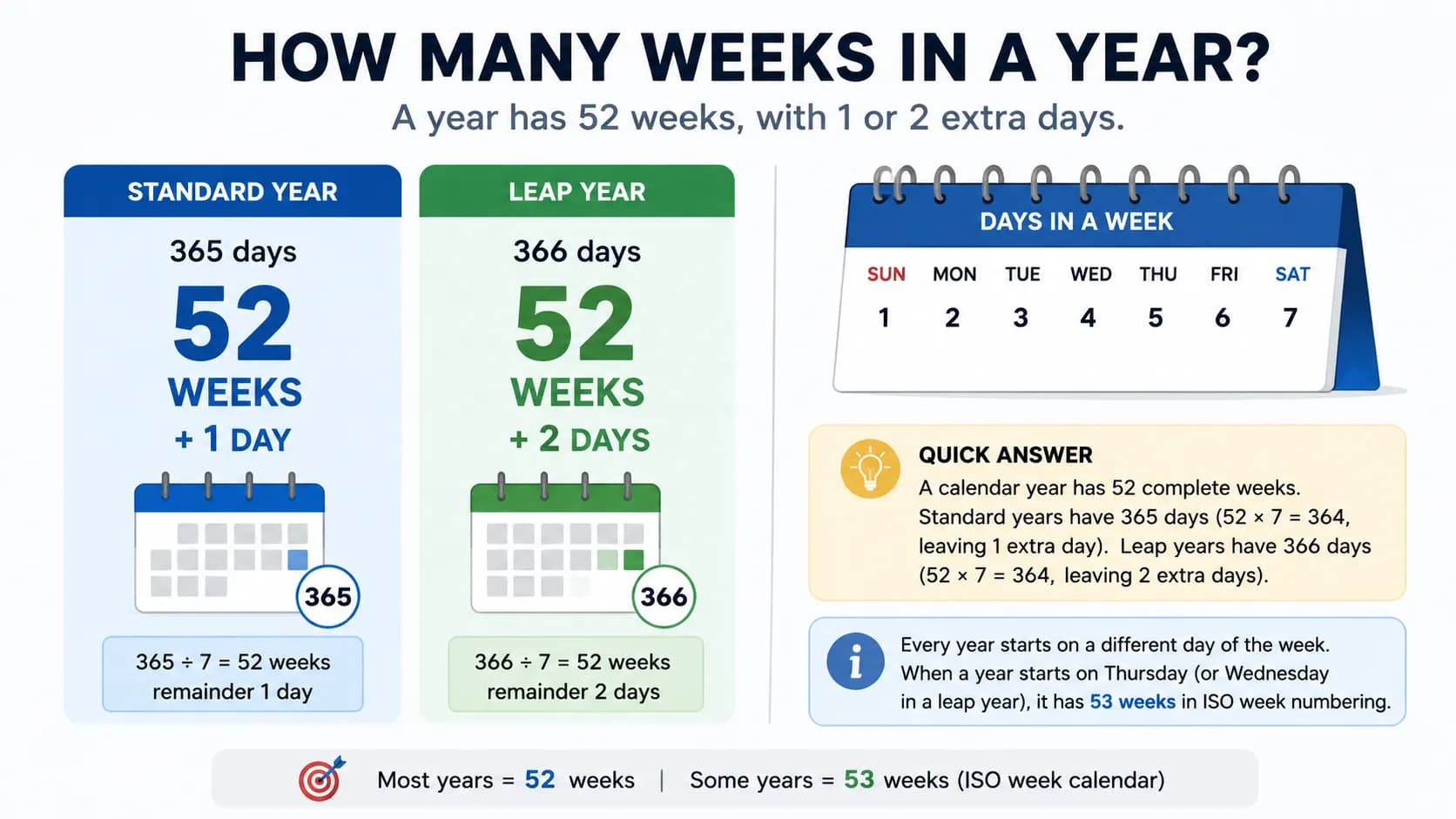
A year has 52 weeks and 1 day.
365 days ÷ 7 = 52 weeks + 1 day
In a leap year (366 days) = 52 weeks + 2 days.

0

Join this conversation
A year has 52 weeks and 1 day.
365 days ÷ 7 = 52 weeks + 1 day
In a leap year (366 days) = 52 weeks + 2 days.
When people ask, “How many weeks are in a year?” the simple answer is 52 weeks. However, a year does not contain exactly 52 weeks. A standard year has 365 days, while a leap year has 366 days. Since one week contains 7 days, the extra days are why some calendar years can have a 53rd week.

A standard year has 365 days. To find the number of weeks, divide 365 by 7:
365 ÷ 7 = 52 weeks and 1 day
This means a standard year contains 52 complete weeks plus 1 extra day.
For example, 52 weeks contain:
52 × 7 = 364 days
There is therefore one day left over in a 365-day year.
A leap year has 366 days because February has 29 days instead of 28. Dividing 366 by 7 gives:
366 ÷ 7 = 52 weeks and 2 days
So, a leap year contains 52 complete weeks plus 2 extra days.
These extra days gradually change the day of the week on which dates fall from one year to the next.
The confusion about 52 or 53 weeks usually comes from calendar week numbering. Although every year has at least 52 complete seven-day periods, some calendar systems number the weeks in a way that results in a year having Week 53.
The most commonly used international system is the ISO week-date system. Under this system, a year can have either 52 or 53 numbered weeks. The exact number depends on how the days of the week line up at the beginning and end of the year.
A 53-week year is not an extra seven days added to the normal length of the year. Instead, it is a result of how calendar dates are grouped and numbered into weeks.
Year Type | Days | Complete Weeks |
|---|---|---|
Standard year | 365 | 52 weeks + 1 day |
Leap year | 366 | 52 weeks + 2 days |
ISO calendar year | Varies | 52 or 53 numbered weeks |
A month does not have a fixed number of weeks. February has 28 or 29 days, while other months have 30 or 31 days.
For example:
28 days = 4 weeks
29 days = 4 weeks + 1 day
30 days = 4 weeks + 2 days
31 days = 4 weeks + 3 days
This is why saying that every month has exactly four weeks is not technically correct.
So, how many weeks are in a year? In everyday terms, a year has 52 weeks, with one or two additional days depending on whether it is a standard or leap year. However, under certain calendar week-numbering systems, some years have 53 numbered weeks.
The easiest way to remember it is: 365 days = 52 weeks + 1 day, and 366 days = 52 weeks + 2 days.
Also Read: How can students develop better research and writing skills for essays and assignments?

A regular year has 52 weeks and 1 extra day, while a leap year has 52 weeks and 2 extra days. That's because a normal year has 365 days and a leap year has 366 days.
For the longest time, I also thought a year had exactly 52 weeks. Later, I realized that if you actually divide the total number of days by 7, there's always an extra day left over. In a leap year, there are two extra days instead of one.
The calculation is quite simple.
A week has 7 days.
365 ÷ 7 = 52 weeks and 1 day
366 ÷ 7 = 52 weeks and 2 days
That's why calendars don't end perfectly after 52 weeks.
A leap year occurs every four years to keep our calendar aligned with the Earth's orbit around the Sun.
Since the Earth takes about 365.25 days to complete one orbit, we add an extra day to February every four years. This creates a 366-day year, which is why a leap year has 52 weeks and 2 days.
Here are a few interesting facts about weeks in a year:
A regular year has 365 days.
A leap year has 366 days.
Both years contain 52 full weeks.
A regular year has 1 extra day after 52 weeks.
A leap year has 2 extra days after 52 weeks.
| Year Type | Days | Weeks |
|---|---|---|
| Regular Year | 365 | 52 weeks + 1 day |
| Leap Year | 366 | 52 weeks + 2 days |
Knowing this small difference can be useful when planning calendars, calculating work schedules, or understanding how our calendar system works. While we usually say a year has 52 weeks, the complete answer is that a regular year has 52 weeks and 1 day, and a leap year has 52 weeks and 2 days.
Must Read: How do we calculate leap year?
A standard year has 52 full weeks plus 1 extra day (365 days). A leap year has 52 full weeks plus 2 extra days (366 days). Under the ISO 8601 system, some years are officially numbered as having 53 weeks — but no calendar year ever contains 53 complete 7-day weeks.
A week is a period of seven consecutive days. Most modern calendars, including the Gregorian calendar used worldwide, group days into weeks to make scheduling, payroll, and planning easier. The 7-day week has no astronomical basis (unlike the day, month, or year) — it comes from older traditions, including Babylonian and Roman calendars and biblical texts, and was later standardized globally.
| Fact | Answer |
|---|---|
| Weeks in a standard year | 52 complete weeks + 1 day |
| Weeks in a leap year | 52 complete weeks + 2 days |
| Days in a standard year | 365 |
| Days in a leap year | 366 |
| ISO week years | 52 or 53 numbered weeks |
A calendar year has 365 days. Divide by 7: 365 ÷ 7 = 52.142857… That means:
The leftover day never forms a full 53rd week on its own — it just becomes the start of the next year's week count.
Leap years have 366 days: 366 ÷ 7 = 52.285714…
Leap years occur every 4 years, except century years not divisible by 400 (1900 was not a leap year; 2000 was, since it's divisible by 400).
| Year type | Days | Exact weeks | Complete weeks | Leftover days |
|---|---|---|---|---|
| Standard year | 365 | 52.1429 | 52 | 1 |
| Leap year | 366 | 52.2857 | 52 | 2 |
Under the ISO 8601 standard — the international week-numbering system used across Europe and in most business reporting — a year can be officially labeled as having 52 or 53 weeks. ISO weeks always start on a Monday.
A year gets 53 ISO weeks if January 1 falls on a Thursday, or if it's a leap year and January 1 falls on a Wednesday. This does not mean the year has more days — it still has 365 or 366 days. It just means the leftover days at the start and end line up so that an extra week number gets assigned.
| Year | Jan 1 falls on | Leap year? | ISO weeks |
|---|---|---|---|
| 2015 | Thursday | No | 53 |
| 2020 | Wednesday | Yes | 53 |
| 2026 | Thursday | No | 53 |
| 2032 | Thursday | Yes | 53 |
The exact figure for a Gregorian calendar year is:
For comparison, a tropical year (the actual time Earth takes to orbit the Sun — about 365.2422 days) works out to roughly 52.1775 weeks. Leap years exist specifically to keep the calendar aligned with this solar cycle.
| Context | Weeks per year | Notes |
|---|---|---|
| Standard calendar year | 52 (+1 day) | Gregorian, 365 days |
| Leap year | 52 (+2 days) | Gregorian, 366 days |
| ISO week year | 52 or 53 | ISO 8601; depends on starting weekday |
| Retail / accounting fiscal calendar (4-4-5) | 52, occasionally 53 | Splits the year into 13 four-week periods; adds a 53rd week roughly every 5-6 years to stay aligned with the calendar |
| US federal fiscal year | 52 (+1 or 2 days) | Runs Oct 1 – Sep 30; it's date-based, not week-based, so it follows the same 52-week pattern as any other 365/366-day period |
| School year (typical US) | ~36 instructional weeks | September–June, excludes breaks |
| Work weeks (typical US) | ~50 | 52 weeks minus ~10 public holidays |
Yes, under ISO 8601. When a standard year starts on a Thursday, or a leap year starts on a Wednesday or Thursday, the ISO calendar counts 53 weeks. The year itself still has 365 or 366 days; the extra week number just accounts for how the leftover days line up.
Also read:
Sources:
If this question was asked 5 years ago, I would say there is nothing known as digital marketing, but today, there are thousands of companies generating tonnes of revenue only with digital marketing. So there is tremendous scope provided you learn it form a good institute and also learning SEO will be an added advantage.

So, the question says how many weeks are there in a year. As we all know there are about 365,242 days in a year. According to the Gregorian calendar, 1 year is equivalent to 365 days but in the astronomical calendar 6hours and 4years once in February was added. So, in a year there are about 52 weeks.

Generally, in a year there are approximately 52 weeks but leap year occurs every 4year so, in a leap year there are about 52weeks in addition to 2 days in a year. A calendar year starts in January and ends in the month of December. Now there are different calculations of the number of days, weeks in a year. If the first day of January is on Saturday then next week will begin on the second day of January. If it is a leap year then the last day of December can also be a new week. So, there are more than 52 weeks in a year i.e 52 weeks and 1day in case of a non-leap year and 52weeks 2days in case of a leap year. These are an extra one or two days that make an extra week in a year though it’s an incomplete week. 2021 is not a leap year so, the current week number 2021 says that there are about 52 weeks 1day in this year as the year starts on 1st January which is Friday and also ends on Friday which is 31st of December. This describes how many weeks in one year and how it’s calculated.
Also Read :- How many hours in a week?
Weeks in a year calculation. One 12 months has approximately 52 weeks.
Weeks in a not unusual Year One calendar, a commonplace 12 months has three hundred and sixty-five days:
1 commonplace yr = twelve months = (three hundred and sixty five days) / (7 days/week) = fifty two.
143 weeks = fifty two weeks + 1 day
Weeks in a leap year. One calendar soar 12 months and occurs every four years, except for years which might be dividable with the aid of 100 and not divisible by four hundred.
One calendar jump year has three hundred and sixty-six days,
whilst February has 29 days: 1 leap yr = 366 days = (366 days) / (7 days/week) = 52.286 weeks = fifty two weeks + 2 days