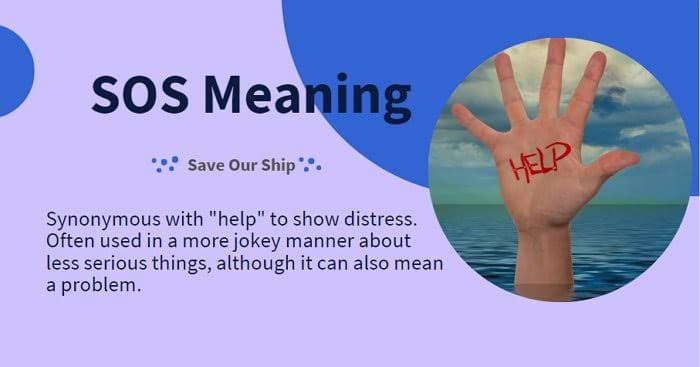
SOS is a widely recognized distress signal used to indicate that someone needs immediate help, especially in emergency situations. Contrary to popular belief, SOS does not officially stand for any specific phrase such as "Save Our Ship" or "Save Our Souls."
The signal was introduced in the early 1900s as an international Morse code distress signal. In Morse code, SOS is represented as:
... --- ...
This pattern was chosen because it is simple, easy to remember, and difficult to confuse with other signals during transmission.
Many people assume SOS is an abbreviation for phrases like:
- Save Our Ship
- Save Our Souls
- Send Our Succor
While these expressions are often associated with SOS, they were created after the signal became popular and were never its official meaning.
Why Was SOS Chosen?
The main reason SOS became the international distress signal was its simplicity. During emergencies at sea, operators needed a signal that could be transmitted quickly and recognized easily, even under poor communication conditions. The Morse code pattern for SOS met those requirements perfectly.
Where Is SOS Used Today?
Although modern communication technology has evolved significantly, SOS remains one of the most recognized emergency signals in the world. It can be found in:
- Emergency communication systems
- Maritime distress procedures
- Aviation emergencies
- Smartphone emergency features
- Survival and rescue situations
In my opinion, one reason SOS has remained relevant for so long is its universal recognition. Even people who know little about Morse code often understand that SOS signals danger or a request for urgent assistance.
Overall, SOS is not an acronym with an official expansion. It is an internationally recognized distress signal that became famous because of its simple Morse code pattern and its effectiveness during emergencies.
Also Read: What does ibm stand for?