
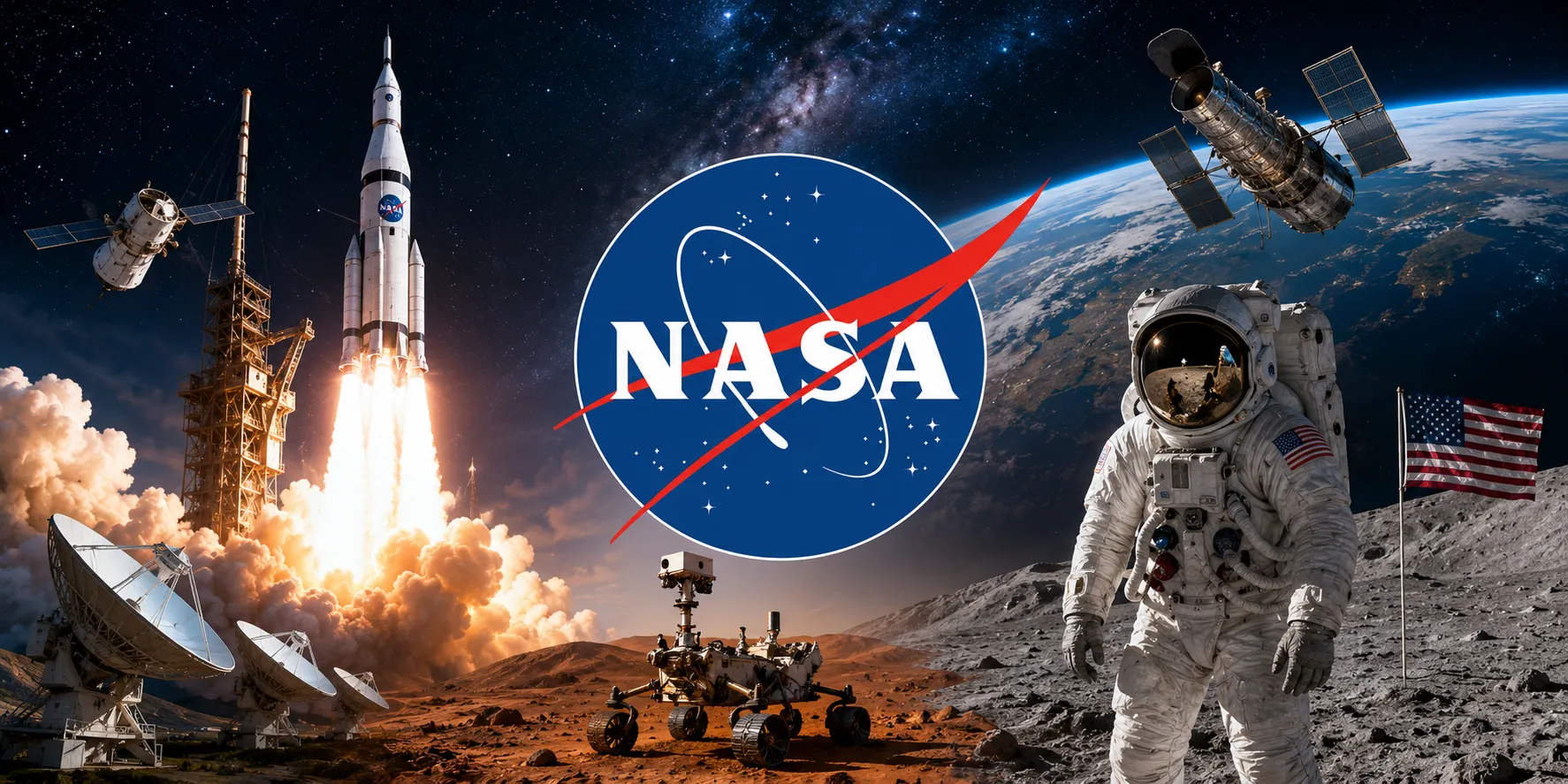
NASA stands for the National Aeronautics and Space Administration. It is the civilian space agency of the United States, responsible for space exploration, aeronautics research, Earth science, planetary science, astrophysics, and the development of advanced space technologies. NASA was officially established on July 29, 1958, and began operations on October 1, 1958, succeeding the National Advisory Committee for Aeronautics (NACA).
NASA's mission extends far beyond sending astronauts into space. The agency studies Earth's climate, the Sun, the Moon, planets, asteroids, distant galaxies, and the universe itself, while also developing technologies that benefit everyday life on Earth. Its research has contributed to advances in satellite communications, GPS, weather forecasting, aviation, robotics, medical technology, and scientific discovery. Today, NASA works with universities, private companies, and international space agencies to expand human knowledge and prepare for future exploration of the Moon and Mars.
Organization Overview
NASA operates through multiple research centers, laboratories, launch facilities, and mission control centers across the United States.
| Feature | Details |
|---|---|
| Full Name | National Aeronautics and Space Administration |
| Founded | July 29, 1958 |
| Began Operations | October 1, 1958 |
| Headquarters | Washington, D.C., United States |
| Parent Government | United States Federal Government |
| Primary Mission | Space exploration, scientific research, aeronautics, and technology development |
| Major Fields | Human spaceflight, Earth science, planetary science, astrophysics, heliophysics, aeronautics |
NASA conducts both robotic and human space missions, making it one of the world's leading scientific and space research organizations.
Responsibilities
NASA has a wide range of scientific and technological responsibilities.
-
Exploring the Moon, Mars, and deep space.
-
Sending astronauts on space missions.
-
Launching scientific satellites and spacecraft.
-
Studying Earth's climate, weather, oceans, and atmosphere.
-
Researching planets, stars, galaxies, and black holes.
-
Developing advanced space technologies.
-
Improving aircraft and aviation safety through aeronautics research.
-
Monitoring asteroids and near-Earth objects.
-
Conducting experiments aboard the International Space Station (ISS).
-
Inspiring STEM education and supporting scientific research worldwide.
These responsibilities make NASA both a space exploration agency and a scientific research organization.
Major Programs & Achievements
NASA has led some of the most important missions in the history of space exploration.
| Program / Mission | Achievement |
|---|---|
| Apollo Program | Landed the first humans on the Moon in 1969. |
| Space Shuttle Program | Completed 135 reusable space shuttle missions between 1981 and 2011. |
| International Space Station (ISS) | Long-term international scientific research in low Earth orbit. |
| Hubble Space Telescope | Revolutionized our understanding of galaxies, stars, and the universe. |
| James Webb Space Telescope | Studies the early universe, distant galaxies, and exoplanets. |
| Mars Rovers | Spirit, Opportunity, Curiosity, and Perseverance have transformed our understanding of Mars. |
| Voyager Missions | First spacecraft to explore the outer planets and enter interstellar space. |
| Artemis Program | Aims to return humans to the Moon and prepare for future missions to Mars. |
One of NASA's current flagship initiatives is the Artemis Program, which seeks to establish a sustainable human presence on and around the Moon while testing technologies needed for future crewed missions to Mars.
Importance
NASA's work benefits both space exploration and everyday life on Earth.
Its importance includes:
-
Expanding scientific knowledge about the universe.
-
Improving weather forecasting through Earth-observing satellites.
-
Monitoring climate change and natural disasters.
-
Advancing aviation safety and aircraft technology.
-
Supporting communication and navigation technologies.
-
Driving innovation in robotics, engineering, and materials science.
-
Inspiring future generations of scientists, engineers, and astronauts.
-
Contributing to international cooperation in space exploration.
Many technologies originally developed for NASA missions have later found applications in medicine, transportation, consumer electronics, manufacturing, and public safety.
Similar Organizations
Several countries operate their own space agencies, but each has different responsibilities and missions.
| Organization | Country / Region | Primary Focus |
|---|---|---|
| NASA | United States | Space exploration, aeronautics, Earth science, and technology research |
| European Space Agency (ESA) | Europe | Collaborative European space missions and scientific research |
| ISRO | India | Space technology, satellite launches, planetary exploration, and public services |
| JAXA | Japan | Space science, Earth observation, and aerospace research |
| CNSA | China | Human spaceflight, lunar exploration, and deep-space missions |
NASA frequently collaborates with many of these organizations on international scientific missions and exploration projects.
Common Misconceptions
"NASA only sends astronauts into space."
No.
Human spaceflight is only one part of NASA's work. The agency also studies Earth, develops aircraft technologies, explores the solar system, researches distant galaxies, and monitors climate and space weather.
"NASA studies only space."
Incorrect.
NASA also conducts extensive research on Earth's atmosphere, oceans, weather systems, climate, and aviation technologies, helping scientists better understand our own planet.
"NASA is a military organization."
No.
NASA is a civilian government agency. Although it sometimes collaborates with other U.S. government organizations on technology and research, its primary mission is peaceful scientific exploration and research.
"NASA works alone."
Not true.
NASA regularly partners with international space agencies, universities, research institutions, and commercial companies to carry out complex scientific missions and space exploration projects.
Frequently Asked Questions (FAQs)
1. What does NASA stand for?
NASA stands for National Aeronautics and Space Administration. It is the civilian space agency of the United States.
2. When was NASA established?
NASA was established on July 29, 1958, and officially began operations on October 1, 1958.
3. What is NASA's main mission?
NASA's mission is to explore space, conduct scientific research, improve aeronautics, study Earth and the universe, and develop technologies that benefit humanity.
4. What are NASA's most famous missions?
Some of NASA's best-known missions include the Apollo Moon landings, the Hubble Space Telescope, Mars rovers, the Voyager spacecraft, the International Space Station, the James Webb Space Telescope, and the ongoing Artemis Program.
5. Is NASA preparing to send humans to Mars?
Yes.
NASA's long-term exploration strategy includes using the Artemis Program to establish a sustained human presence on the Moon and develop the technologies and experience needed for future crewed missions to Mars.
Must Read: Why NASA Is Afraid of ISRO and What Are Their Achievements?